2026. 4. 3. 00:41ㆍComputerScience/Computer Architecture
QuCo: Efficient and Flexible Hardware-Driven Automatic Configuration of Tile Transfers in GPUs (HPCA'26)

Abstract
The growing complexity and parallelism demands of modern GPU workloads have driven architectural innovations toward asynchronous tile transfers (ATTs) to overlap computation and data movement. While ATT units such as the NVIDIA’s Tensor Memory Accelerator (TMA) introduce high-throughput memory transfers, programmers must deal with wavefront specialization, select tile sizes, queue slots, and synchronization primitives, all of which are hardware-specific and workload-dependent. Existing GPU libraries fall short—offering limited ATT support and configurability—so developers still resort to manual exploration of this vast parameter space, which is laborious, error-prone, and fundamentally limits performance portability across GPUs.
In this work, we present QuCo (Queue Configurator), a single lightweight hardware unit embedded in the GPU that fully automates the ATT configuration process. Inspired by Blackwell GPU design, QuCo includes a compact RISC-V processor, small memory structures for instructions and data, and a GPU Specification Table (GST) storing key architectural parameters. Using the GST and workload characteristics, along with built-in heuristics, QuCo computes optimal queue configurations at kernel launch. This relieves the programmer of the tedious, time-consuming task of tuning and offline profiling, while simultaneously increasing post-compilation performance portability.

Introduction
Despite their high memory bandwidth and parallelism, modern GPUs still suffer from underutilization in memory-bound workloads due to latency and transfer bottlenecks [13], [21], [31], [32]. In particular, a prominent source of performance loss is the inefficient overlap of memory operations and computation, leaving GPU resources underutilized and idle [16]. To try to remedy this, some recent GPU designs incorporate support for asynchronous tile transfers (ATTs).
What are ATTs? Traditional GPU data movement relies on synchronous load/store instructions issued at cache-line granularity involving a large number of registers (large bank register and scoreboard for tracking dependencies). In contrast, ATTs allow the programmer to specify multidimensional “tiles” of data to be directly moved in bulk between global memory and the on-chip scratchpad without involving vast register usage and costly data dependency tracking, while simultaneously freeing issue slots and increasing energy efficiency. This trend toward ATTs is exemplified by state-of-the-art NVIDIA’s Tensor Memory Accelerator (TMA) [6] originally introduced in the Hopper architecture.
Why are ATTs so important? ATTs enable fine-grained overlap of data movement with computation, turning what would be idle cycles into useful work and substantially improving utilization on memory-bound kernels. Crago et al. [8] demonstrated these benefits across a broad spectrum of domains—including machine learning, graph analytics, genomics, and scientific simulations—showing that any workload can exploit asynchronous transfers to hide memory latency, boost throughput, and achieve more consistent performance on modern GPUs.
What is the problem with ATTs? In practice, programming ATTs efficiently is notoriously challenging [47]. On the one hand, different wavefronts(=warp) must be assigned to specific tasks to improve overlap between memory access and computation [5], [8], [11], [26], technique termed wavefront specialization. Typically, one wavefront issues the ATT requests while the rest perform computation, requiring careful synchronization to guarantee that data is ready in the on-chip scratchpad (Local Data Share or LDS, from now on)—often through custom barriers.
On the other hand, workload characteristics such as data reuse, access patterns, and arithmetic intensity vary not only across applications but often within kernels. To simplify this burden, NVIDIA provides a high-level abstraction for the TMA (the cuda::pipeline), which wraps producer-consumer wavefronts into reusable queues [34], but developers must still manually tune and manage these descriptors (tile sizes, strides, and LDS destinations) and explicitly specialize kernels at the wavefront level to orchestrate producer (memory-transfer) and consumers (compute) wavefronts. Therefore, although a well-tuned ATT program can yield substantial benefits, the mechanism introduces significant complexity, tightly couples code to hardware and makes GPU programming more challenging, less portable, and less maintainable [5].
To illustrate how the achieved performance is both kernel and architecture-specific, we present two motivating experiments (the experimental setup is detailed in Section IV). Figure 1a shows that applying the best configuration of ATTs from one kernel to another can degrade performance by up to 1.2×, underscoring the need for workload-specific tuning. Figure 1b shows similar sensitivity across architectures: using the best ATT setup optimized for one GPU (e.g., R9 Nano) on others (e.g., MI-100, Radeon 530) leads to performance drops of up to 1.4×. These results highlight the paramount importance of adaptive, per-kernel and per-architecture configuration to fully exploit ATT-based workloads. (워크로드의 특성, GPU HW config 특성에 맞는 ATT 설정의 필요성)
To bridge the gap between performance, programming effort and flexibility on ATT-supported GPUs, we introduce QuCo
(Queue Configurator), a lightweight mechanism that fully automates configuration of ATT in a low-effort, high performance, and portable manner. Specifically, QuCo abstracts the complex, kernel- and architecture-dependent tasks of selecting tile sizes, determining queues configuration, and performing LDS(Local Data Share, scratchpad (SRAM)) partitioning and allocation. By abstracting these low-level details, QuCo eliminates manual tuning, delivering optimized, workload- and hardware-specific configurations in a single execution and preserving the same post-compilation binary portable across diverse GPU architectures (same family).
Should QuCo be implemented as hardware or software?
The mechanisms and algorithms we present are agnostic to implementation. While a vendor could deploy QuCo as a
software solution (e.g. within the JIT compiler or at library level), we advocate for a lightweight hardware realization: a single module per GPU die. This is for several reasons. Existing libraries (such as CUTLASS [35] or cuBLAS [33]) struggle to keep pace: static, offline-tuned implementations cannot adapt to new workloads or microarchitectures without extensive reengineering, and closed-source “black-box” solutions offer limited configurability. In virtualized or multi-tenant environments, each GPU partition may require its own ATT configuration, exponentially increasing profiling overhead. Additionally, relying solely on a software solution risks exposing proprietary GPU micro-architectural details, something that some manufacturers may be reluctant to do. Finally, software solutions cannot adapt swiftly to DVFS transitions or newly introduced microarchitectural features. Ultimately, while our fundamental contributions are agnostic to this decision, the remainder of this paper focuses on hardware because of these additional benefits.
Specifically, our QuCo hardware solution adds to the GPU die a single compact RISC-V microcontroller along with small on-chip memories for microcode and runtime data, as well as a GPU Specification Table (GST) that stores key architectural parameters. At kernel launch, the RISC-V core executes lightweight firmware to dynamically compute optimal parameters. By performing this computation entirely on-chip and autonomously—without host intervention or exposure of hardware details—QuCo delivers rapid, secure, and portable ATT configuration across evolving GPU architectures.
* This aligns with the trend of GPUs delegating non-compute tasks to dedicated microcontrollers. For example, NVIDIA’s Blackwell architecture introduces the AI Management Processor (AMP) [36], [37], a fully programmable RISC-V context scheduler at the front of the GPU pipeline.
Overall, our key contributions are as follows:
• We propose QuCo, a dedicated mechanism that fully automates the configuration of ATTs, including tile sizing, slot allocation, and LDS partitioning, eliminating the need for manual tuning.
• We demonstrate that QuCo abstracts the intricate details of ATT configuration and achieves near-optimal performance, matching or outperforming fine-tuned manual configurations, while dramatically reducing programmer effort.
• We evaluate QuCo across multiple GPU architectures, showcasing its portability, queue reuse, and design space complexity to validate its efficiency and adaptability.
Background
Building on the challenges of manual ATT programming, the current state-of-the-art ATT engine is NVIDIA’s Tensor Memory Accelerator (TMA) introduced in the H100 [6]. TMA implements the same producer–consumer wavefront specialization and asynchronous global-to-shared memory transfers we target with ATT, but its primary optimization is to feed Tensor Cores with operand tiles. (텐서 코어가 끊기지 (놀지) 않도록, 계속 타일이 Shared memory에 준비되도록) By contrast, our work treats ATT as an orthogonal mechanism—equally applicable to tensor and non-tensor workloads—providing a general framework for any bulk transfer engine.
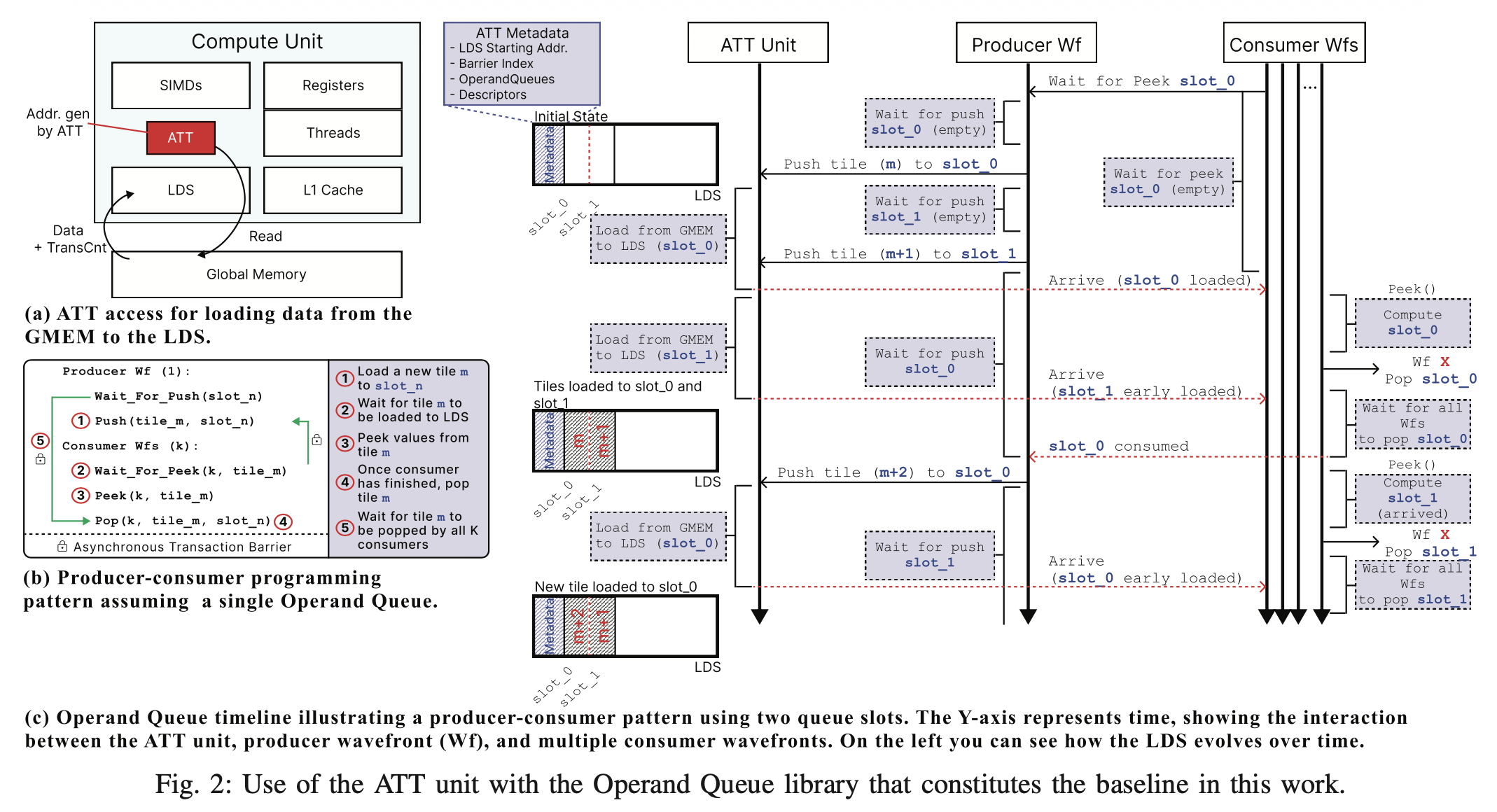
The ATT is tightly integrated within the Compute Unit, bypassing the L1 cache to directly issue read memory requests to global memory every clock cycle. It generates its own addresses and transfer counts, writing incoming data directly to LDS without software-managed synchronization or thread involvement, as illustrated in Figure 2a.
ATT operations are initiated using a copy descriptor—a compact structure that defines the global memory address, and number of elements to transfer. Once triggered by a single thread within a wavefront(warp), ATT hardware takes over, managing address generation, stride calculations, and boundary conditions. This offloads complexity from the programmer, enabling efficient data transfer between global memory and shared memory (LDS).
A key innovation in the ATT mechanism is its synchronization model, which introduces specialized asynchronous barriers to optimize coordination between producer and consumer threads. In particular, ATTs use asynchronous transaction barriers, splitting synchronization into two phases: arrive and wait. Producer threads signal progress by executing a non-blocking arrive command when shared data is ready, allowing them to continue independent work without stalling. Consumer threads issue a wait command when they need the data, blocking until all producers signal arrive. This two-step process allows early threads to use idle cycles for other tasks, avoiding the inefficiencies of busy-wait synchronization.
By using these hardware-accelerated asynchronous barriers and transaction-based synchronization, ATTs enable efficient overlapping of memory transfers and computation, enhancing parallelism and performance. However, fully harnessing its potential still requires direct involvement from the programmer. Mismanaging dependencies, like ordering memory operations incorrectly, can cause race conditions, deadlocks, or incorrect results, complicating debugging. Additionally, configuring ATT descriptors requires detailed knowledge of the underlying data layout and workload, demanding precision in defining parameters such as dimensions and memory strides.
To reduce the programming complexity associated with using ATTs, NVIDIA offers the cuda::pipeline API, which enables efficient usage of the TMA for asynchronous memory operations via single- and multi-stage pipelines [34]. Inspired by these abstractions, we implement a high-level interface for managing producer-consumer synchronization tailored to our evaluation framework, which we refer to as Operand Queues.
Operand Queues encapsulate the use of ATT descriptors, and are initialized through a queue descriptor containing the key parameters required for asynchronous memory transfers. These include the global memory addresses, tile dimensions, memory strides, and LDS destination. Once configured, Operand Queues autonomously manage the low-level ATT operations, further abstracting the details of data movement.
Notably, state-of-the-art libraries such as CUTLASS3+CuTe and ThunderKittens offer high-level ATT abstractions (TMA pipelines and asynchronous I/O, respectively) that help automate data movement and computation overlap. However, to obtain hardware-specific peak ATT performance, they place the burden on the programmer [47]. As a result, effective use of these libraries still demands a deep understanding of the underlying GPU microarchitecture. (여전히 프로그래머의 부담 존재 -> tile size, pipeline depth, warp 분배, TMA 설정 등 전부 사람이 수동으로 설정해주어야한다.)
Our Operand Queues implementation is based on a producer-consumer scheme where a dedicated wavefront (producer) loads tiles into the LDS using functions like Push() and synchronizes via Wait_For_Push(), while multiple consumer wavefronts access these tiles using Peek() and Pop(), coordinated through asynchronous transaction barriers. Figure 2b summarizes this interaction. Figure 2c shows a detailed timeline of a queue with two slots (slot_0 and slot_1), highlighting the interaction between the ATT unit and the producer and consumer wavefronts. It emphasizes how memory transfers are decoupled from computation, allowing tiles to be early loaded and asynchronously consumed, thus improving data availability and overall throughput.
QUCO UNIT
In this section, we introduce the Queue Configurator (QuCo) unit, a hardware solution that automates the configuration of any ATT-enabled GPU and makes it completely transparent to the programmer, while ensuring portability. QuCo abstracts away the low-level management of operand queues, tile sizes and LDS partitioning and allocation, providing an architecture-agnostic and performance-aware solution for efficient utilization. Internally, the QuCo unit includes a customized RISC-V microcontroller aimed at executing a lightweight firmware that dynamically computes optimized queue configurations—such as tile sizes and queue slots—based on the particularities of both the target kernel and the GPU architecture.
Figure 3 provides an overview of the GPU architecture, illustrating where the QuCo unit, a single hardware block, resides relative to key components such as the Command Processor (CP), the Asynchronous Compute Engine (ACE), the Compute Units (CUs), and the multi-banked shared L2 cache with its attached DRAM banks. A zoomed-in view of the QuCo unit reveals its internal structure: a lightweight RISC-V microcontroller, the GPU Specification Table (GST) containing essential architectural parameters, and a memory subsystem for microcode and local variables. QuCo is integrated closely with the CP, allowing it to access kernel launch parameters and architectural metadata early, enabling configuration before threads are scheduled for execution. This ensures that all memory operands (e.g., queue descriptors, ATT descriptors, and barrier pointer) are ready in the LDS before compute begins, preventing stalls and enabling seamless kernel execution. (QuCo의 실행에 병목 혹은 문제가 생기지 않도록 구현되었다고 설명하는 부분)

As shown in Figure 4, QuCo acts as a control unit: the programmer specifies the number of operand queues based on the characteristics of the kernel (Figure 4a), and QuCo autonomously configures all low-level parameters—tile sizes, slot counts, LDS allocation, and synchronization barriers— tuned to the kernel’s characteristics and the GPU capabilities (Figure 4b). Once initialized, these queues serve as the interface between QuCo and the execution pipeline. As shown in Figure 4c, both the ATT Unit and the Sync Unit within each CU retrieve their configuration directly from the queues set up by QuCo, enabling efficient and autonomous data movement and coordination. As a result, data movement through the ATT queues becomes transparent to the programmer, who is no longer required to manage descriptors, compute offsets, or handle synchronization.
In workloads with multiple kernels having different memory demands, QuCo can reconfigure the LDS layout with minimal overhead by overlapping the reconfiguration time Fig. 3: Overview of the GPU architecture with the QuCo unit. with the ongoing kernel’s execution, maintaining the benefits of automatic tuning. These reconfigurations involve updating the ATT metadata—descriptor pointers, LDS base addresses, and synchronization barrier indices—which QuCo modifies inplace based on the new kernel’s needs. Notably, the contents of the operand queues do not need to be erased or reinitialized. Since the queues are pointer-based, resizing them only requires adjusting memory offsets and slot counts, allowing QuCo to dynamically grow or shrink queues without incurring significant data movement or synchronization costs.
A key strength of QuCo is its portability. The embedded RISC-V microcontroller runs firmware that adapts to various GPU configurations without requiring recompilation or manual tuning. This decoupling ensures consistent, optimized performance across different GPU models and future architectures. By centralizing the configuration logic and abstracting hardware-specific details, QuCo hides the complexity of using ATTs while maintaining high efficiency and scalability.
Microarchitecture
QuCo is implemented using a single compact in-order RISC-V processor supporting the RV32IMF instruction set [39], which includes integer arithmetic and single-precision floating-point operations. This 32-bit ISA proves sufficient for typical ATT-related operations (Section III-B), which involve address arithmetic, offset calculations, and basic multiplication or division instructions for scaling and aligning memory segments. This in-order design follows a simple five-stage pipeline, significantly limiting hardware complexity while retaining enough performance to handle the control logic needed for ATT initialization and reconfiguration.
Upon GPU startup, QuCo fetches its first instruction from an 8 KiB ROM containing compact firmware. This firmware handles accessing architectural parameters, computing optimal queue configurations, and writing the resulting descriptors into LDS memory. Operating independently from the GPU’s wavefront scheduling, QuCo uses a 2 KiB local data buffer to store local variables, data structures, and previously computed configurations. The data buffer is addressable via QuCo’s private address space, supporting repeated invocations and persistent metadata.
A key data structure accessible to QuCo is the GPU Specification Table (GST), a 256-byte read-only block populated by the vendor at manufacturing time. The GST contains essential architectural parameters such as memory latencies,
clock frequency, LDS size, number of compute units, and arithmetic throughput (e.g., FP32 fused-multiply-accumulate operations per cycle). During boot, the QuCo’s firmware reads these values into local registers and data buffers to initialize the subsequent configuration process. (부팅동안 큐코에서 일어나는 일)
Once QuCo has gathered the necessary architectural data, it configures the ATT units by calculating optimal tile sizes and queue slots for the number of ATT queues requested by the user (Figure 4a). The LDS is logically partitioned, reserving a small region for metadata and ATT descriptors, with the remaining space allocated to operand queues (Figure 4b). QuCo writes all the required ATT descriptors, tile parameters, and slot pointers to the LDS, making them accessible to the ATT units. After completing the configuration, QuCo signals each ATT unit to load the updated descriptors and begins loading data from main memory to the LDS. This enables seamless operation, where the programmer interacts with the LDS using a queue structure (as introduced in Section II), while the ATT and the Sync Unit handle the low-level and complex asynchronous data movement behind the scenes.
After configuration, QuCo enters an idle state but remains ready for reactivation. In dynamic workloads with multiple kernels, particularly those with heterogeneous memory demands, QuCo can be reinvoked to recompute queue layouts and update descriptors. Importantly, the RISC-V processor is decoupled from the main compute pipeline, ensuring that configuration tasks do not interfere with wavefront scheduling, memory requests, or execution flow, following the trend of some recent GPUs to offload configuration logic to specialized hardware[37].
* The fact that QuCo is a hardware block implemented within the GPU ensures that data in the GST is not exposed.
* To further minimize microarchitectural overhead, QuCo could be embedded as part of existing RISC-V configuration cores, such as the AMP already included in NVIDIA Blackwell.
Implemented Configuration Strategy : Algorithm
The configuration logic executed by the QuCo firmware takes as input both static architectural parameters—retrieved from the GPU Specification Table (GST)—and dynamic workload information such as compute intensity, vector sizes, and the number of queues requested by the user, including their intended usage (streaming or stationary), dimensional length (e.g., K dimension in a matrix), and data type size. Using this information, the QuCo unit, is able to deliver a per-kernel configuration that maximizes memory throughput and computational overlap while respecting architectural constraints. These include LDS capacity, hardware barrier limits, and maximum tile sizes supported by the ATT. (이런것도 고려를 한다는 의미)
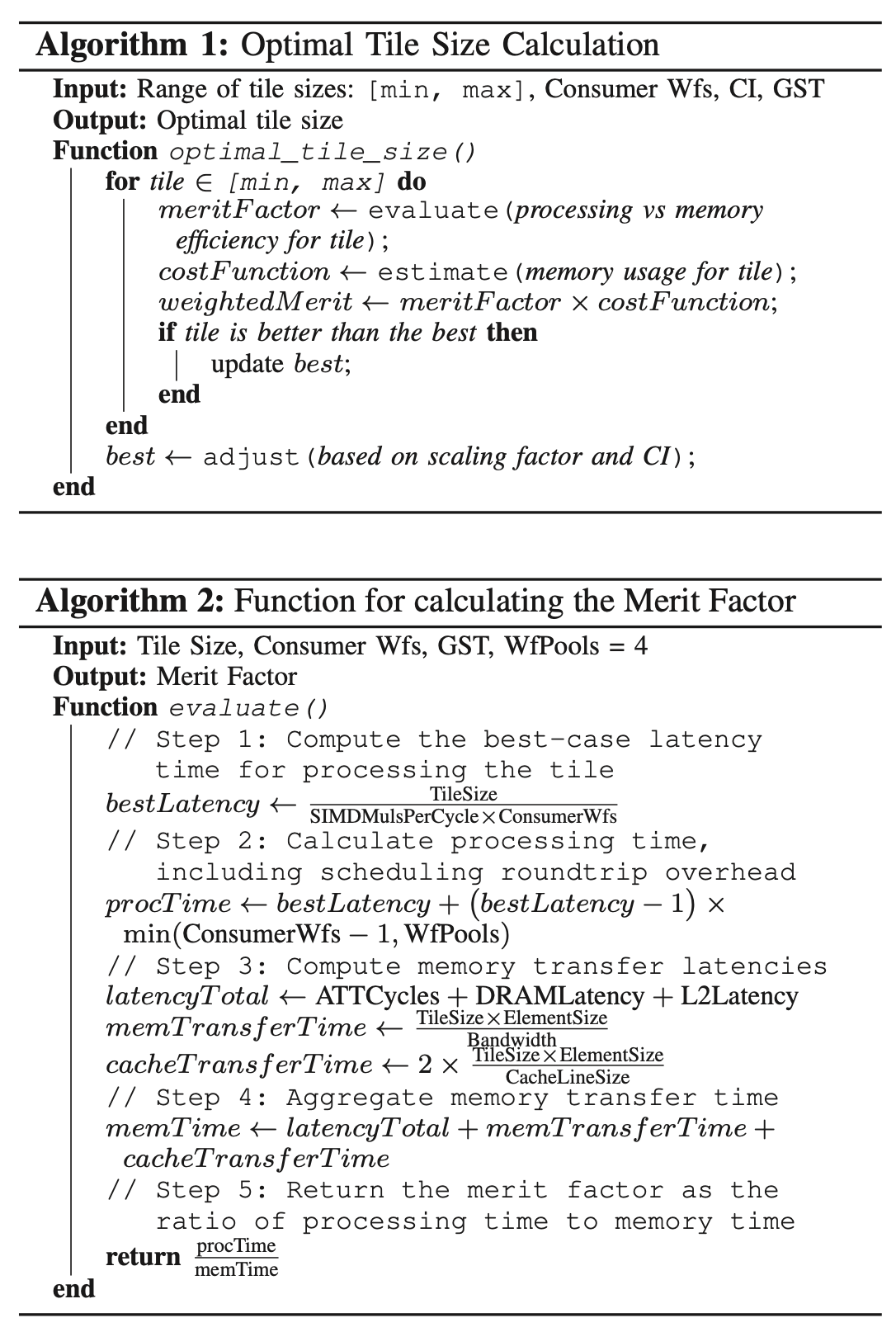
The first step is to determine the optimal tile size (Algorithm 1). QuCo explores tile sizes ranging from a minimum of 64 elements—the cache line size—up to 8,192 elements, a limit based on design-space exploration and bounded by the LDS size specified in the GST. (타일 사이즈: 최소 64 ~ 최대 8192) For each candidate tile size, it evaluates a merit factor: the ratio of tile processing time to memory transfer time. Processing time is estimated using kernel-specific compute intensity (CI)—ratio of operations to memory traffic—wavefront utilization, and compute throughput (e.g., MACs per cycle), plus a scheduling roundtrip overhead due to wavefront dispatch limitations (e.g., the scheduler waiting a full roundtrip before issuing the next instruction).
Transfer time is based on memory latency, DRAM bandwidth, ATT latency, and L2 cache behavior; the 2× factor in the cache transfer time models the bidirectional nature of data movement between global memory and LDS—accounting for both read and potential write traffic during tile transfers. All parameters are hardware-specific and retrieved from the GST, ensuring the algorithm is tuned to the target GPU. The merit factor effectively models the rate at which tiles are processed versus the rate at which they are fetched, a critical factor in GPU performance (see Algorithm 2 for more details).
In addition to the merit factor, the algorithm computes a cost function to evaluate resource usage for transferring a tile, considering latency, bandwidth, and cache-line constraints. The cost function aggregates the memory system costs into a normalized score. It combines tile-dependent latency—estimated as the sum of ATT, DRAM, and L2 latencies divided by the tile size—with two additive penalties: one inversely proportional to DRAM bandwidth and another inversely proportional to cache-line size. (반비례한다는 의미) This models the relative impact of limited bandwidth and fine-grained cache-line usage on tile transfers.
Together, the merit factor and cost function are combined into a weighted merit score, computed as the product of both values, which determines the suitability of a given tile size. (merit * cost -> 적절한 타일 사이즈를 찾는다) This ensures that the selected tile provides the optimal balance between computational efficiency and memory efficiency.
After iterating over possible tile sizes, the algorithm adjusts for the kernel’s CI (Compute Intensity) : scaling up the tile size for low-CI kernels, CI<1 (i.e., Elementwise or Dot-Product) to improve memory throughput (연산밀도가 낮으면, 타일을 좀 더 키워도 돼) and scaling down for high-CI kernels, CI>4 (i.e., Matrix-Matrix multiplication) to balance memory and computation overlap (Section IV describes the complete list of the kernels and benchmarks used in our evaluation). This ensures the tile size aligns with the kernel’s characteristics.

After determining the tile size, the QuCo unit computes the optimal number of slots for each queue (Algorithm 3). This step begins by counting the number of streaming and stationary queues, as the allocation strategy prioritizes streaming queues to maximize performance, while reserving remaining resources for stationary queues. (streaming 먼저 -> stationary 그 다음으로 나머지 LDS에 할당)
For streaming queues, QuCo uses a hardware-aware adaptation of Little’s Law to balance queue depth with kernel latency and tile throughput. Little’s Law provides a relationship between the rate at which items enter a system, the time they spend being processed, and the average number of items, and has been widely applied within the fields of operations management and computer architecture [28].
Using this approach, the ideal number of slots required for a streaming queue is derived directly from the ratio of memory transfer time (i.e., the rate at which tiles are loaded into the LDS by ATT transfers) to the total time needed to compute a tile. This ratio determines the number of slots to ensure the queues are neither underutilized nor overly provisioned (this is calculated by useLittlesLaw() in Algorithm 3). (리틀의 법칙으로 스트리밍 큐의 슬롯 수 계산)
The number is then further adjusted based on the number of compute units. Specifically, the algorithm reduces the number of tiles when more CUs are active, as higher CU utilization increases pressure on the memory system. This adjustment mitigates memory contention and balances workload distribution, ensuring that queues operate efficiently under varying compute loads.
Subsequently, the last step ensures that the calculated number of slots fits within the available LDS capacity. If the required slots exceed the LDS constraints—due to tile size or memory limitations—an alternative strategy is employed. In this fallback approach, the number of slots is re-evaluated and scaled based on the workload’s CI. For low-CI workloads (e.g., Elementwise), more slots are allocated to improve memory throughput. (연산 밀도가 낮으면, 슬롯을 여러개 할당하여, 메모리 throughput 증가) For high-CI workloads (e.g., Matrix-Matrix multiplication), fewer slots are chosen to reduce memory pressure and better overlap computation and memory accesses. (연산 밀도 높으면, 슬롯 개수를 줄임) Once streaming queues have been configured, QuCo proceeds to assign resources to stationary queues using the remaining LDS capacity evenly. This two-stage allocation ensures that latency-sensitive transfers are prioritized.
(streaming -> stationary Q, streaming 큐의 경우 계속 데이터가 들어오면, 슬롯이 부족할 경우 병목이 발생, 반면 stationary 큐는 LDS에 한 번 올려두면 슬롯 수 부족 시 성능 저하의 영향을 덜 받음)
After computing the optimal tile size and number of slots for each queue, QuCo proceeds to physically allocate and initialize the queues in the LDS. Next to the already allocated space used for ATT metadata, it allocates contiguous blocks for each queue, setting up their corresponding ATT descriptors pointers (see the example in Figure 4b). Each queue includes its tile size, number of slots, and synchronization barriers. These descriptors are written directly into memory regions that are visible to the ATT units, enabling immediate use. By embedding this decision logic directly into the GPU hardware, QuCo transforms what is a complex developer-managed task into a fully autonomous process.
Simulation Environment
We evaluate QuCo using MGPUSim [44], a cycle-accurate GPU simulator calibrated with an AMD R9 Nano (GCN3
ISA), representative of mid-range GPUs. All main results (Section V-B) use this setup, while portability tests cover two additional GPUs: the high-end MI-100 and low-power Radeon 530 (Table II; results in Section V-E). We extended MGPUSim to support ATTs between global memory and LDS, modeling background data movement, operand queue management, and LDS coordination accurately at functional and cycle levels.
Despite building upon an AMD platform, our ATT design is architecture-neutral, allowing any GPU with asynchronous global-to-shared memory transfers to benefit from QuCo’s automated configuration. Moreover, performance primarily depends on general GPU characteristics (e.g., bandwidth, compute throughput) rather than ISA-specific features, ensuring broad applicability. The performance trends from our ATT evaluations align closely with results reported for other ATT hardware, such as NVIDIA TMA-enabled GPUs [29], [30], [47], confirming the validity and generality of our approach.

Linear Algebra Kernels and Benchmarks
We evaluate QuCo and validate our ATT implementation using wavefront-specialized kernels—spanning both fundamental linear-algebra kernels and state-of-the-art workloads [47]—that cover diverse data-access patterns and compute intensities across domains such as machine learning, analytics, genomics, and signal processing (Table I). To compute the CI of each kernel, we calculate the ratio of floating-point operations to global memory traffic without ATT acceleration. This method captures the compute-to-memory balance of each workload without interference from asynchronous transfers. Since CI is an algorithmic property, its value remains constant across architectures and configurations, and it is used by QuCo to classify the kernel, as described in Section III-B.
Workloads range from element-wise operations to dense matrix multiplications, exposing memory- and compute-bound scenarios. Some require precise queue tuning and others test ATT’s ability to overlap data movement with computation. These kernels demand explicit wavefront specialization and fine-grained synchronization support and no existing benchmark suites (e.g., Rodinia, Parboil, Polybench) have yet been adapted or specifically designed to utilize modern asynchronous memory transfers in GPUs, whether in software or via hardware mechanisms like NVIDIA’s TMA6.
Design Space
QuCo addresses the combinatorial complexity of ATT-enabled kernels, where selecting tile sizes and queue slot counts across multiple operand queues leads to a vast design space. The number of valid configurations grows exponentially with the number of queues and tuning parameters. Table I summarize the possible configurations for each workload. For our evaluation, we constrain the search space to practical ranges: tile sizes from 64 to 8,192 elements, and queue slots from 1 to 8. This results in billions to quadrillions of possible combinations. Manually exploring this space would be prohibitively expensive, but QuCo simplifies the process by automatically identifying high-performing configurations in a single pass, eliminating the need for manual tuning.
Kernels
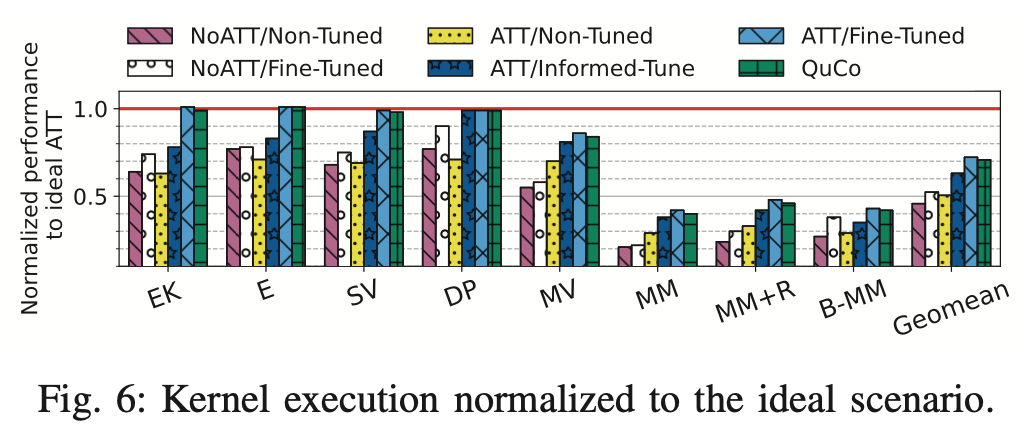
For the eight kernels listed in Table I, Figure 6 compares the performance obtained for six execution cases: For kernels like Elementwise or Dot-Product, the tile size range is reduced, yielding 5 discrete options. i) NoATT/Non-Tuned; ii) NoATT/Fine-Tuned; iii) ATT/Non-Tuned; iv) ATT/Informed-Tuned; v) ATT/Fine-Tuned; and vi) QuCo. As detailed below, each case represents a different level of optimization and complexity in kernel execution. All the results are normalized to an ideal ATT implementation, where the ATT operates with an unlimited LDS, allowing all data to fit into the LDS and enabling continuous tile loading without LDS constraints (an ideal-scenario performance bound).
The first two cases, NoATT/Non-Tuned and NoATT/Fine-Tuned, evaluate kernels that do not take advantage of the ATT. NoATT/Non-Tuned corresponds to a naive implementation, where memory operations and computations are poorly optimized, using small tile sizes, and as a result, issuing more memory requests, leading to suboptimal application performance (see Figure 6). In contrast, NoATT/Fine-Tuned is the configuration obtained through extensive design space exploration to optimize kernel parameters—such as tile size and queue slots—resulting in significantly improved performance across all cases, particularly for simpler workloads such as ElementwiseK and Dot-Product.
Among the ATT-based implementations, ATT/Non-Tuned serves as a baseline case where the ATT unit is used without proper tuning of tile sizes and queue slots. This lack of optimization leads to poor performance across all kernels. Without informed parameter selection, tile sizes may be too small to leverage memory bandwidth or too large to fit efficiently into LDS memory, causing stalls. Similarly, the number of queue slots may be insufficient to overlap memory transfers and compute, leading to idle cycles and creating substantial performance gaps compared to the upper bound. While this approach achieves competitive results on lightweight workloads, it struggles with more sensitive kernels that require precise alignment between memory transfers and computation. For example, in Dot-Product and Elementwise, the lack of tuning not only prevents overlap but can introduce wavefront scheduling stalls or memory contention.
ATT/Informed-Tuned incorporates heuristic-based configurations inspired by NVIDIA guidelines, using tile sizes between 64 and 256 elements and queue slots between 2 and 4 (double or quadruple buffering) [30]. This approach delivers strong performance for simpler kernels like ElementwiseK, Elementwise, Sumvectors, and Dot-Product, but its performance for Matrix-Vector, Matrix-Matrix, Matrix-Matrix+Reduction and Batched-Matrix-Matrix remains suboptimal due to the increased complexity and resource demands of these workloads.
The ATT/Fine-Tuned represents an exhaustive design space exploration for each kernel, identifying the best possible tile and slot configurations through repeated profiling. This approach requires substantial computational effort, with the GPU kernel executed once per configuration, and requiring manual tuning. Obviously, this optimized execution case provides the best performance, particularly for Matrix-Vector, Matrix-Matrix, Matrix-Matrix+Reduction and Batched-Matrix-Matrix workloads, since these kernels can now make better use of GPU resources, achieving performance closer to the ideal.
However, the complexity of this approach makes it impractical for complex kernels like these four (as shown in Table I, 2.6e+14 kernel launches would be required for Matrix-Matrix or Batched-Matrix-Matrix workloads). This situation is even worse for real-world applications (e.g., Whisper Tiny with 2.1e+17 kernel launches).
In contrast, the ability of the QuCo unit to automatically select values for the configuration parameters of the queues based on architectural characteristics and kernel properties, fully eliminates the need for this impractical exhaustive tuning. As shown in Figure 6, QuCo achieves performance that is slightly below ATT/Fine-Tuned but consistently outperforms NoATT/Fine-Tuned, ATT/Non-Tuned, and ATT/Informed-Tuned across all the kernels. Without requiring any manual tuning or host-side intervention, QuCo provides near-optimal configurations with significantly reduced complexity.
For the challenging matrix kernels (Matrix-Matrix, Matrix-Matrix + Reduction and Batched-Matrix-Matrix), all methods—QuCo included—fall significantly short of the ideal performance due to limited data reuse and large working set sizes that exceed the LDS capacity. In this case, the K tile dimension cannot fully reside in LDS, requiring frequent re-fetches from global memory and increasing pressure on the L2 cache. This effect is especially pronounced when compared to the theoretical unlimited-LDS baseline, which manages to retain all tile fragments in on-chip memory.
Interestingly, the Batched-Matrix-Matrix kernel presents a special case where ATT/Fine-Tuned and QuCo slightly outperforms the NoATT/Fine-Tuned implementation. We observe this is largely due to the overhead of managing a high number of asynchronous barriers. This behavior is consistent with prior work [47], where the authors report achieving performance on par with optimized cuBLAS and Triton implementations. This benchmark serves as a representative case illustrating that while QuCo enables automated configuration, not all workloads benefit equally from the ATT.
To understand the memory-level effects of QuCo’s automated configuration, we analyzed DRAM request activity during kernel execution. Figure 5 shows a complete trace of DRAM requests for the kernels. In the NoATT/Fine-Tuned case (blue line), memory accesses occur abruptly and irregularly, with idle periods between request spikes. This behavior indicates poor overlap between memory access and computation, as global memory loads are issued synchronously by the kernel.
In contrast, the QuCo-enabled configuration (red line) maintains a consistently high level of DRAM activity throughout execution. As previously discussed, the Batched-Matrix-Matrix kernel reflects the synchronization overhead and its impact at the memory level.
This sustained throughput is the result of asynchronous tile transfers using Operand Queues, which are configured and allocated by QuCo, to later load data tiles into the LDS. Because memory and compute are overlapped more effectively, the kernel completes significantly earlier than its no ATT counterpart. This result demonstrates QuCo’s ability to exploit the available DRAM bandwidth and better hide memory latency even without programmer intervention.

Ablation Study
To further understand the impact of each heuristic used by QuCo, we conducted an ablation study over the linear algebra kernels. Figure 7 compares QuCo against progressively degraded versions of its design, each removing a key heuristic: i) CU-aware slot scaling; ii) Little’s Law-based slot sizing; and iii) CI-based tile and slot scaling. All results are normalized to the ATT/Fine-Tuned baseline. For simpler kernels (e.g., ElementwiseK, Elementwise, Dot-Product), removing Little’s Law occasionally improves performance due to coincidental alignment between CI-scaling and queue pressure—e.g., 4 slots versus 8. However, for more complex kernels (e.g., Matrix-Vector, Matrix-Matrix, Matrix-Matrix + Reduction, Batched-Matrix-Matrix), disabling CU-aware rounding leads to over-allocation of slots—4, or even 8 slots instead of 2—causing increased memory contention and reducing performance by up to 25%. Disabling CI scaling further worsens this, as larger tiles and excessive slots overload the memory system—e.g., tile sizes of 1024 or 2048 with 4 or 8 slots, compared to 512 with 2 slots—leading to slowdowns of nearly 40% (notably in Matrix-Matrix + Reduction). See Table III for the optimal configurations selected by QuCo.

Benchmarks
Figure 8 shows the efficiency of QuCo in the context of the six benchmarks listed in Table I. In particular, we present a performance comparison of three ATT-based implementations: i) ATT/Semi-Tuned, where only the first layer is tuned and its ATT configuration is reused for all subsequent layers—a realistic but suboptimal programmer strategy; ii) ATT/Fine-Tuned, our baseline for this evaluation, which uses exhaustive per-layer tuning of tile size and queue slots within the subset of the design space we covered to obtain the results for the ATT/Fine-Tuned configuration in Figure 8; and iii) QuCo, which automatically configures queues and descriptors for each layer.
As shown, QuCo consistently outperforms all other implementations, highlighting its ability to automatically adapt to heterogeneous layers and varying memory requirements without any programmer intervention. In the full-model benchmarks, QuCo performs comparably to or better than the ATT/Fine-Tuned baseline with an average improvement of up to 1.15×. In some cases, such as AlbertV2 or Whisper-Tiny, the ATT/Semi-Tuned configuration performs notably worse due to insufficient overlap between memory transfers and computation (suboptimal tile sizes and number of slots in the queue), confirming that reuse of early-layer tuning is not robust across a full model execution path.
The benefits of QuCo become more subtle for composite kernels when compared to the ATT/Fine-Tuned baseline. Unlike full DNN models with highly heterogeneous layers, these kernels consist of fewer and more uniform layers. As a result, static configurations tend to perform reasonably well, and the performance gap between manual tuning and automatic configuration narrows. Still QuCo dynamically allocates queue slots and tiles based on each layer’s properties, consistently matching or slightly outperforming the ATT/Fine-Tuned implementation across the full execution range.
Despite QuCo being a fully automated mechanism, it delivers performance consistently comparable to or better than the best manually tuned approach. As reflected in the Geomean column, QuCo achieves the highest average speedup across all benchmarks, underscoring its practicality as a robust and architecture-aware solution for real-world GPU workloads.
To further explore the performance benefits of per-layer or per-kernel queue reconfiguration in QuCo, we conduct an ablation study on the Whisper-Tiny model, analyzing speedups on a layer-by-layer basis across the four different implementations. Although the full model contains over 827 layers, many of them are structurally identical. For this evaluation, we extract the set of unique layer types and evaluate them individually. These layers are not executed sequentially in practice, but are isolated here to understand how QuCo behaves under different configurations and compute patterns. Figure 9 shows the speedup over the ATT/Fine-Tuned baseline. The x-axis denotes individual layers—both convolutional and fully connected—while the y-axis shows the relative speedup achieved by each configuration. This fine-grained comparison highlights how ATT performance varies depending on layer size, properties, and queue configurations across layers.
Although the ATT/Fine-Tuned configuration leverages exhaustive tuning to achieve strong performance across many layers, it is inherently limited by the scope and granularity of the design space explored manually. In practice, evaluating even a modest set of tile sizes and queue slots for each layer results in an overwhelming number of combinations, making per-layer tuning prohibitively expensive. For large models like Whisper-Tiny, which consists of hundreds of unique layers, maintaining optimal queue configurations across all of them becomes infeasible without automation.
Additionally, the ATT/Semi-Tuned configuration highlights the pitfall of the one size does not fit all approach, where a static ATT setup is reused across all the different layers. This fixed configuration, selected early in the tuning process based on initial performance profiling, consists of a tile size of [256] elements with [4] slots. While this configuration performs reasonably well in the first few initial layers Conv1d-1 or FC-2, it significantly degrades in later layers such as FC-5, FC-8 or FC-12, where resource demands shift toward either bigger tiles or less occupancy. This behavior reinforces that optimal queue configuration is not only workload-architecture-specific but also layer-specific, and fixed strategies fail to generalize across an entire model.
In contrast, QuCo dynamically reconfigures the queues for each layer based on runtime parameters and architectural constraints, allowing it to navigate a vastly larger design space. As shown in Figure 9, it consistently outperforms both Semi-Tuned and Fine-Tuned approaches, delivering the highest speedup across layers. In deeper, more compute-intensive layers, QuCo demonstrates its ability to identify high-impact configurations. For instance, in Conv1d-2, it selects a tile size of [1024] elements and allocates [2] slots—reducing pressure on the memory system and increasing compute throughput—while for FC-3 and FC-4, it configures a more conservative tile size of [256] elements with [2] slots—to increase both memory occupancy and compute throughput—outperforming both baselines significantly.

Portability
To evaluate the portability of QuCo across a range of GPU hardware platforms, we execute the same set of kernels—the exact same compiled binary in case of QuCo—presented in Section V-B on three distinct GPU architectures: a high-end GPU (MI-100), a desktop-class GPU (R9 Nano, our baseline), and a mobile-like low-power GPU (Radeon 530) implementing asynchronous tile transfer operations. Details in Table II.
Figure 10 shows the speedup achieved comparing three implementations: the NoATT/Fine-Tuned baseline, an ATT/Fine-Tuned setup (exhaustively selected for each kernel and device), and QuCo. Despite differences in architectural scale, QuCo consistently delivers near-optimal performance across all platforms without requiring any manual tuning.
On the MI-100 (Figure 10a), the most compute-rich device, QuCo performs within range of the best tuned configuration across all kernels, confirming its ability to scale to large architectures. On the R9 Nano (Figure 10b), our base platform, QuCo again matches ATT/Fine-Tuned performance, with nearly identical trends to those reported in Section V-B. Finally, on the resource-constrained Radeon 530 (Figure 10c), QuCo demonstrates a key strength: when compute resources are scarce, the baseline NoATT implementation is unable to overlap memory and compute effectively. In contrast, the ATT-based implementations, and especially QuCo, achieve up to 2× speedup, highlighting the importance of overlapping computation with memory transfers for hiding memory latency under severe resource constraints.
QuCo’s ability to deliver optimal or near-optimal configurations without any tuning effort and preserving the same post-compilation binary—regardless of the architecture—demonstrates its portability and robustness. The variability of configurations selected by QuCo is illustrated in Table III, where tile sizes and queue slots are shown to differ across kernels and devices, reinforcing that optimal choices are architecture-dependent and validating the need for QuCo’s dynamic, on-device configuration strategy.
To further prove QuCo’s adaptability to workloads with varying characteristics, in Figure 11 we plot the distribution of the unique combinations selected by QuCo when the DNN models and composite kernels are executed on the three GPUs.
Lastly, to underscore the importance of portability, we highlight two dynamic execution scenarios where QuCo proves especially valuable: dynamic voltage and frequency scaling (DVFS) and multi-tenancy. First, in environments with DVFS, GPU parameters may vary during runtime, breaking assumptions made by statically tuned configurations. Although QuCo performs setup only at kernel launch, it adapts at each invocation, allowing reconfiguration between kernels without intervention. Second, in multi-tenant systems, cloud-shared GPUs or virtually partitioned GPUs, available compute and memory resources may be partitioned or shared across concurrent workloads. High-level libraries typically fail to adjust under these constraints. In contrast, QuCo dynamically infers and adjusts queue configurations based on actual resource availability at runtime, ensuring robust performance without sacrificing portability.

DVFS
To further prove QuCo’s adaptability, we conduct a frequency-aware evaluation of the Whisper-Tiny DNN on the MI100 GPU under three dynamic voltage and frequency scaling (DVFS) scenarios, inspired by prior work [1]. For each scenario, we adjust the operating frequency layer by layer. Each layer is evaluated under two queue configuration policies: QuCo-SW, which always assumes the default GPU frequency (1500 MHz), and QuCo-HW, which adapts to the current GPU frequency when each layer is executed. Results are normalized per layer to the corresponding QuCo-SW baseline scenario.
The first scenario (Decreasing Freq.) explores a monotonic frequency decrease, starting at 1500 MHz and gradually reducing to 900 MHz. This exposes a significant benefit for QuCo-HW in later layers. Interestingly, at FC-
5 (1300 MHz), a seemingly minor adjustment—e.g., reducing the tile size from 512 to 256—leads to measurable speedups. QuCo-HW achieves up to 11% performance improvement over its software-based counterpart.
The second one (Decreasing-Increasing Freq.) simulates a U-shaped frequency curve, decreasing from 1500 MHz to 950 MHz by layer 7, then increasing back to 1500 MHz. Here, early and late layers show negligible differences, but layers with intermediate frequency drops (e.g., FC-3,4,5, and 11) benefit from QuCo-HW’s adaptive queue sizing. Across all layers, QuCo-HW delivers up to 10% performance improvement compared to QuCo-SW.
The third one (Decreasing-Holding Freq.) decreases the frequency progressively until layer 6, and then, holds it constant at 1000 MHz for the rest of the layers. While the early layers see little change, QuCo-HW consistently improves performance in the later layers by adapting to the sustained low frequency, demonstrating cumulative gains. This results in a speedup of up to 17% compared to QuCo-SW.
Overall, across the three scenarios, performance differences between QuCo-SW and QuCo-HW are negligible in the first few layers, since both operate at the same frequency, and therefore, generate identical queue configuration. Similarly, in many intermediate layers, although the queue configurations may differ, the layers themselves tend to be linear and exhibit low CI, making them less sensitive to tuning. Despite this, QuCo-HW consistently outperforms the static software-based approach in most layers, thanks to its ability to adapt queue configurations dynamically based on the actual operating frequency during execution.

Incurred Latency, Area and Energy Overhead
QuCo includes a simple RISC-V microcontroller implementing the RV32IMF instruction set. At the 28 nm FDSOI technology node from ST Microelectronics and operating frequency of 700 MHz, the area estimate for the core is 0.027 mm2 [42]. As for the memory structures, the combined memory subsystem of QuCo of 8 KiB (firmware)+2 KiB (data)+256-byte GST, occupies a physical footprint of approximately 0.014 mm2, and, according to CACTI, delivers an access latency of 0.37 ns with a dynamic energy cost of 0.0032 nJ per read and 0.0061 nJ per write. Assuming an IPC=1, we estimate QuCo reconfiguration takes 6,300–8,300 cycles—much less than kernel execution time. These results demonstrate that QuCo adds negligible area overhead, latency and energy consumption, making it suitable for integration into modern GPU designs.
RELATED WORK
Several wavefront scheduling methods have been proposed to optimize GPU performance [8], [22], [23], [25], [31], [43]. Early techniques, such as Loose Round-Robin (LRR) and Greedy Then Oldest (GTO), are widely adopted for intra-group and inter-group wavefront scheduling [22], [23], [25]. However, not a single method uniformly outperforms others across diverse workloads, and scheduling efficiency typically depends on workload characteristics [2] and heavily programmer-dependent. Recent research has tackled wavefront scheduling inefficiencies through innovative approaches. For instance, QoS-aware wavefront scheduling (QAWS) [43] dynamically prioritizes kernels based on Quality-of-Service, significantly reducing response time in simultaneous multi-kernel scenarios without sacrificing overall throughput. Additionally, to mitigate GPU memory latency issues, Snake [31] introduced a chain-based prefetching mechanism that captures stride patterns within and across threads and wavefronts, thereby enhancing memory efficiency and reducing cache contention.
Wavefront specialization is another promising optimization technique mentioned and used in this proposal. Recent works exploring wavefront specialization typically rely on hardware enhancements [4], [8], [18]. Huang et al. [18] adopt an ant colony system algorithm to implement a producer-consumer wavefront model, increasing computational efficiency. Similarly, CudaDMA [4] introduces specialized DMA wavefronts to optimize GPU memory bandwidth by exclusively handling data transfers between shared and global memory. A closely related effort is WASP [8], which proposes compiler and hardware support for automatic wavefront specialization. WASP’s techniques are completely orthogonal and complementary to QuCo: while WASP makes wavefront specialization transparent to the programmer, QuCo automates ATT.
Compared to prior solutions, QuCo delivers dynamic, per-kernel ATT configuration without requiring compiler changes or invasive hardware redesign, offering low integration effort, and runtime adaptability—all while maintaining transparent usage and low area footprint via its RISC-V microcontroller.
Conclusion
As GPUs become more heterogeneous, programming complexity increases. A key example is asynchronous tile transfers (ATTs) between global and shared memory (e.g., NVIDIA’s TMA). Leveraging ATT effectively requires careful producer-consumer coordination and precise configuration based on GPU architecture and kernel behavior. Although frameworks such as NVIDIA’s SDK, CUTLASS3+CuTe or ThunderKittens provide useful abstractions, they do not eliminate the burden of manually selecting optimal parameters, wavefront specialization, or fine-grained synchronization barriers.
To address this, we introduce Queue Configurator (QuCo), a novel, lightweight hardware unit embedded in the GPU. At kernel launch, QuCo firmware transparently automates ATT configuration by inferring optimal queue setups from static GPU specification data (GST) provided by the vendor, combined with dynamic kernel features. Our evaluation across multiple GPU platforms and linear algebra kernels shows QuCo achieves performance within 1.04% of expert hand-tuned ATT configurations. Further, for state-of-the-art DNN models and composite kernels—where manual tuning is even less feasible—QuCo consistently outperforms manual attempts, highlighting its potential as a general framework for automated memory-transfer optimization.