2026. 3. 19. 21:22ㆍComputerScience/Parallel Programming
Chap5. Memory architecture and data locality
In this chapter we will focus on the on-chip memory architecture of the GPU and begin to study how one can organize and position data for efficient access by a massive number of threads. The CUDA kernels that we have studied so far will likely achieve only a tiny fraction of the potential speed of the underlying hardware. This poor performance is because global memory, which is typically implemented with off-chip DRAM, tends to have long access latency (hundreds of clock cycles) and finite access bandwidth.
While having many threads available for execution can theoretically tolerate long memory access latencies, one can easily run into a situation in which traffic congestion in the global memory access paths prevents all but a very few threads from making progress, thus rendering some of the cores in the streaming multiprocessors (SMs) idle. To circumvent such congestion, GPUs provide a number of additional on-chip memory resources for accessing data that can remove the majority of traffic to and from the global memory. In this chapter we will study the use of different memory types to boost the execution performance of CUDA kernels.
CUDA memory types
A CUDA device contains several types of memory that can help programmers to improve the compute to global memory access ratio. Fig. 5.2 shows these CUDA device memories. At the bottom of the figure, we see global memory and constant memory. Both these types of memory can be written (W) and read (R) by the host. The global memory can also be written and read by the device, whereas the constant memory supports short-latency, high-bandwidth read-only access by the device. We introduced global memory in Chapter 2, Heterogeneous Data Parallel Computing, and we will look at constant memory in detail in Chapter 7, Convolution.
Another type of memory is the local memory, which can also be read and written. The local memory is actually placed in global memory and has similar access latency, but it is not shared across threads. Each thread has its own section5.2 of global memory that it uses as its own private local memory where it places data that is private to the thread but cannot be allocated in registers. This data includes statically allocated arrays, spilled registers, and other elements of the thread’s call stack.
Registers and shared memory in Fig. 5.2 are on-chip memories. Variables that reside in these types of memory can be accessed at very high speed in a highly parallel manner. Registers are allocated to individual threads; each thread can access only its own registers (see the “CPU versus GPU Register Architecture” sidebar). A kernel function typically uses registers to hold frequently accessed variables that are private to each thread. Shared memory is allocated to thread blocks; all threads in a block can access shared memory variables declared for the block. Shared memory is an efficient means by which threads can cooperate by sharing their input data and intermediate results. By declaring a CUDA variable in one of the CUDA memory types, a CUDA programmer dictates the visibility and access speed of the variable.

CPU vs GPU Register Architecture
The different design objectives across the CPUs and GPUs result in different register architectures. As we saw in Chapter 4, Compute Architecture and Scheduling, when CPUs context switch between different threads, they save the registers of the outgoing thread to memory and restore the registers of the incoming thread from memory. In contrast, GPUs achieve zero-overhead scheduling by keeping the registers of all the threads that are scheduled on the processing block in the processing block’s register file. This way, switching between warps of threads is instantaneous because the registers of the incoming threads are already in the register file. Consequently, GPU register files need to be substantially larger than CPU register files.

Lifetime tells the portion of the program’s execution duration when the variable is available for use: either within a grid’s execution or throughout the entire application. If a variable’s lifetime is within a grid’s execution, it must be declared within the kernel function body and will be available for use only by the kernel’s code. If the kernel is invoked several times, the value of the variable is not maintained across these invocations. Each invocation must initialize the variable in order to use it. On the other hand, if a variable’s lifetime is throughout the entire application, it must be declared outside of any function body. The contents of these variables are maintained throughout the execution of the application and available to all kernels.
In general, the more resources each thread requires, the fewer the number of threads that can reside in each SM.
We saw in Chapter 4, Compute Architecture and Scheduling, how register usage can be a limiting factor for occupancy. Shared memory usage can also limit the number of threads that can be assigned to each SM. For example, the A100 GPU can be configured to have up to 164 KB of shared memory per SM and supports a maximum of 2048 threads per SM. Thus for all 2048 thread slots to be used, a thread block should not use more than an average of (164 KB)/(2048 threads)=82 B/thread.
both Mds and Nds will have 256 elements. If we want to change the size of Mds and Nds, we need to change the value of TILE_WIDTH and recompile the code. The kernel cannot easily adjust its shared memory usage at runtime without recompilation.
Summary
In summary, the execution speed of a program in modern processors can be severely limited by the speed of the memory. To achieve good utilization of the execution throughput of a CUDA devices, one needs to strive for a high compute to global memory access ratio in the kernel code. If the ratio is low, the kernel is memory-bound. That is, its execution speed is limited by the rate at which its operands are accessed from memory.
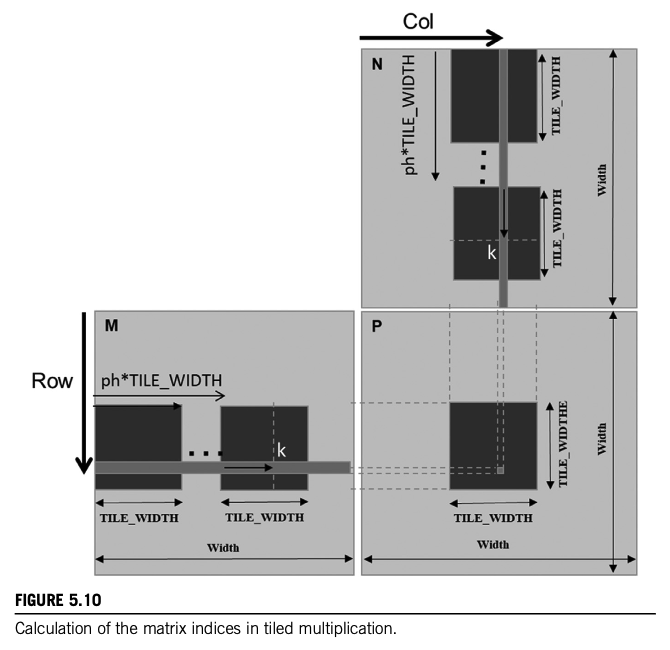
CUDA provides access to registers, shared memory, and constant memory. These memories are much smaller than the global memory but can be accessed at much higher speed. Using these memories effectively requires redesign of the algorithm. We use matrix multiplication as an example to illustrate tiling, a popular strategy to enhance locality of data access and enable effective use of shared memory. In parallel programming, tiling uses barrier synchronization to force multiple threads to jointly focus on a subset of the input data at each phase of the execution so that the subset data can be placed into these special memory types to enable much higher access speed.
However, it is important for CUDA programmers to be aware of the limited sizes of these special types of memory. Their capacities are implementation dependent. Once their capacities have been exceeded, they limit the number of threads that can be executing simultaneously in each SM and can negatively affect the GPU’s computation throughput as well as its ability to tolerate latency. The ability to reason about hardware limitations when developing an application is a key aspect of parallel programming.
Although we introduced tiled algorithms in the context of CUDA C programming, it is an effective strategy for achieving high-performance in virtually all types of parallel computing systems. The reason is that an application must exhibit locality in data access to make effective use of high-speed memories in these systems. For example, in a multicore CPU system, data locality allows an application to effectively use on-chip data caches to reduce memory access latency and achieve high performance. These on-chip data caches are also of limited size and require the computation to exhibit locality. Therefore the reader will also find the tiled algorithm useful when developing a parallel application for other types of parallel computing systems using other programming models.
Our goal for this chapter was to introduce the concept of locality, tiling, and different CUDA memory types. We introduced a tiled matrix multiplication kernel using shared memory. We further studied the need for boundary test conditions to allow for arbitrary data dimensions in applying tiling techniques. We also briefly discussed the use of dynamically sized shared memory allocation so that the kernel can adjust the size of shared memory that is used by each block according to the hardware capability. We did not discuss the use of registers in tiling. We will explain the use of registers in tiled algorithms when we discuss parallel algorithm patterns in Part II of the book.
'ComputerScience > Parallel Programming' 카테고리의 다른 글
| [CUDA] Chap7. Convolution (0) | 2026.03.24 |
|---|---|
| [CUDA] Chap6. Performance considerations (0) | 2026.03.20 |
| [CUDA] Chap4. Compute architecture and scheduling (0) | 2026.03.19 |
| [CUDA] Chap3. Multidimensional grids and data (0) | 2026.03.19 |
| [CUDA] Chap2. Heterogeneous data parallel computing (0) | 2026.03.19 |