2026. 3. 24. 16:26ㆍComputerScience/Parallel Programming
Chap7. Convolution
Convolution is an array operation in which each output data element is a weighted sum of the corresponding input element and a collection of input elements that are centered on it.
Because convolution is defined in terms of neighboring elements, boundary conditions naturally arise in computing output elements that are close to the ends of an array. As shown in Fig. 7.3, when we calculate y[1], there is only one x element to the left of x[1]. That is, there are not enough x elements to calculate y[1] according to our definition of convolution. A typical approach to handling such boundary conditions is to assign a default value to these missing x elements. For most applications the default value is 0, which is what we use in Fig. 7.3.

These missing elements are typically referred to as ghost cells in the literature. There are also other types of ghost cells due to the use of tiling in parallel computation. These ghost cells can have significant impact on the effectiveness and/or efficiency of tiling. We will come back to this point soon. Also, not all applications assume that the ghost cells contain 0. For example, some applications might assume that the ghost cells contain the same value as the closest valid data element on the edge.
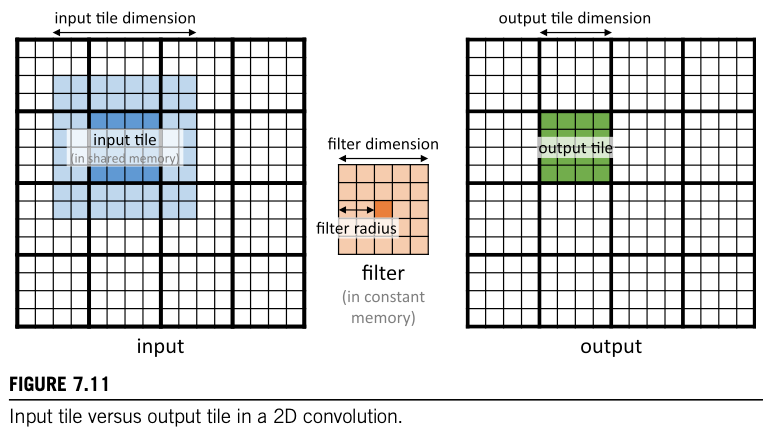
The first step is to define the major input parameters for the kernel. We assume that the 2D convolution kernel receives five arguments: a pointer to the input array, N; a pointer to the filter, F; a pointer to the output array, P; the radius of the square filter, r; the width of the input and output arrays, width; and the height of the input and output arrays, height.
Constant memory and caching
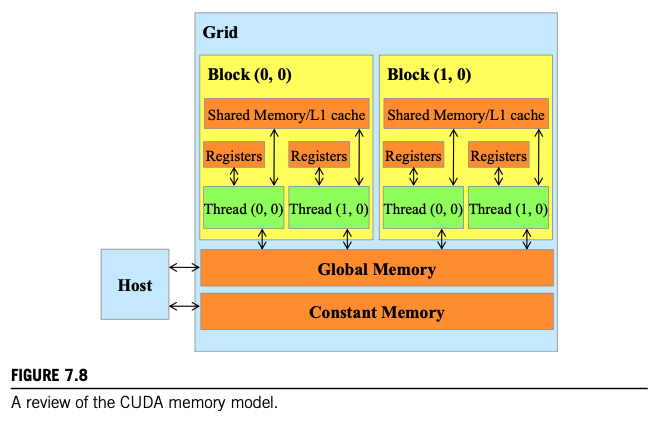
There are three interesting properties in the way the filter array F is used in convolution. First, the size of F is typically small; the radius of most convolution filters is 7 or smaller. Even in 3D convolution the filter typically contains only less than or equal to 73 = 343 elements. Second, the contents of F do not change throughout the execution of the convolution kernel. Third, all threads access the filter elements. Even better, all threads access the F elements in the same order, starting from F[0][0] and moving by one element at a time through the iterations of the doubly nested for-loop in Fig. 7.7. These three properties make the filter an excellent candidate for constant memory and caching (Fig. 7.8).
the CUDA C allows programmers to declare variables to reside in the constant memory. Like global memory variables, constant memory variables are visible to all thread blocks. The main difference is that the value of a constant memory variable cannot be modified by threads during kernel execution. Furthermore, the size of the constant memory is quite small, currently at 64 KB.
Note that this is a special memory copy function that informs the CUDA run-time that the data being copied into the constant memory will not be changed during kernel execution.

Keep in mind that all the C language scoping rules for global variables apply here. If the host code and kernel code are in different files, the kernel code file must include the relevant external declaration information to ensure that the declaration of F is visible to the kernel. Like global memory variables, constant memory variables are also located in DRAM. However, because the CUDA runtime knows that constant memory variables are not modified during kernel execution, it directs the hardware to aggressively cache the constant memory variables during kernel execution. To understand the benefit of constant memory usage, we need to first understand more about modern processor memory and cache hierarchies.
As we discussed in Chapter 6, Performance Considerations, the long latency and limited bandwidth of DRAM form a bottleneck in virtually all modern processors. To mitigate the effect of this memory bottleneck, modern processors commonly employ on-chip cache memories, or caches, to reduce the number of variables that need to be accessed from the main memory (DRAM), as shown in Fig. 7.10.
The processor hardware will automatically retain the most recently or frequently used variables in the cache and remember their original global memory address. When one of the retained variables is used later, the hardware will detect from their addresses that a copy of the variable is available in cache. The value of the variable will then be served from the cache, eliminating the need to access DRAM. There is a tradeoff between the size of a memory and the speed of a memory.
L1 or level 1, is the cache that is directly attached to a processor core, as shown in Fig. 7.10. It runs at a speed close to that of the processor in both latency and bandwidth. However, an L1 cache is small, typically between 16 and 64 KB in capacity. L2 caches are larger, in the range of a few hundred kilobytes to a small number of MBs but can take tens of cycles to access. They are typically shared among multiple processor cores, or streaming multiprocessors (SMs) in a CUDA device, so the access bandwidth is shared among SMs. In some high-end processors today, there are even L3 caches that can be of hundreds of megabytes in size.
Furthermore, since the constant memory is quite small (64 KB), a small, specialized cache can be highly effective in capturing the heavily used constant memory variables for each kernel. This specialized cache is called a constant cache in modern GPUs.
Also, since the size of F is typically small, we can assume that all F elements are effectively always accessed from the constant cache. Therefore we can simply assume that no DRAM bandwidth is spent on accesses to the F elements.
Summary
In this chapter we have studied convolution as an important parallel computation pattern. While convolution is used in many applications, such as computer vision and video processing, it also represents a general pattern that forms the basis of many parallel algorithms. For example, one can view the stencil algorithms in partial differential equation solvers as a special case of convolution; this will be the subject of Chapter 8, Stencil. For another example, one can also view the calculation of grid point force or potential value as a special case of convolution, which will be presented in Chapter 17, Iterative Magnetic Resonance Imaging Reconstruction. We will also apply much of what we learned in this chapter on convolutional neural networks in Chapter 16, Deep Learning.
We presented a basic parallel convolution algorithm whose implementation will be limited by DRAM bandwidth for accessing both the input and filter elements. We then introduced constant memory and a simple modification to the kernel and host code to take advantage of constant caching and eliminate practically all DRAM accesses for the filter elements. We further introduced a tiled parallel convolution algorithm that reduces DRAM bandwidth consumption by leveraging the shared memory while introducing more control flow divergence and programming complexity. Finally, we presented a tiled parallel convolution algorithm that takes advantage of the L1 and L2 caches for handling halo cells.
We presented an analysis of the benefit of tiling in terms of elevated arithmetic-to-global memory access ratio. The analysis is an important skill and will be useful in understanding the benefit of tiling for other patterns. Through the analysis we can learn about the limitation of small tile sizes, which is especially pronounced for large filters and 3D convolutions.
Although we have shown kernel examples for only 1D and 2D convolutions, the techniques are directly applicable to 3D convolutions as well. In general, the index calculation for the input and output arrays are more complex, owing to higher dimensionality. Also, one will have more loop nesting for each thread, since multiple dimensions need to be traversed in loading tiles and/or calculating output values. We encourage the reader to complete these higher-dimension kernels as homework exercises.
'ComputerScience > Parallel Programming' 카테고리의 다른 글
| [CUDA] Chap9. Parallel histogram (0) | 2026.03.24 |
|---|---|
| [CUDA] Chap8. Stencil (0) | 2026.03.24 |
| [CUDA] Chap6. Performance considerations (0) | 2026.03.20 |
| [CUDA] Chap5. Memory architecture and data locality (0) | 2026.03.19 |
| [CUDA] Chap4. Compute architecture and scheduling (0) | 2026.03.19 |