2026. 3. 24. 16:40ㆍComputerScience/Parallel Programming
Chap8. Stencil
The data that is processed by stencil-based algorithms consists of discretized quantities of physical significance, such as mass, velocity, force, acceleration, temperature, electrical field, and energy, whose relationships with each other are governed by differential equations. A common use of stencils is to approximate the derivative values of a function based on the function values within a range of input variable values.
Stencils bear strong resemblance to convolution in that both stencils and convolution calculate the new value of an element of a multidimensional array based on the current value of the element at the same position and those in the neighborhood in another multidimensional array. Therefore stencils also need to deal with halo cells and ghost cells. Unlike convolution, a stencil computation is used to iteratively solve the values of continuous, differentiable functions within the domain of interest.
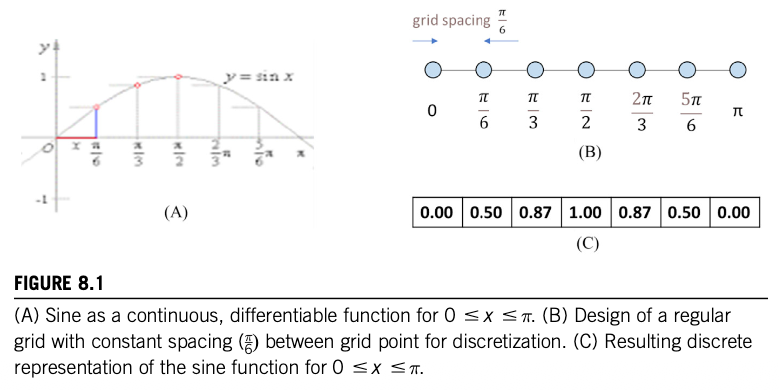
In a discrete representation, one needs to use an interpolation technique such as linear or splines to derive the approximate value of the function for x values that do not correspond to any of the grid points. The fidelity of the representation or how accurate the function values from these approximate interpolation techniques are depends on the spacing between grid points.
Among the three, double-precision numbers offer the best precision and the most fidelity in discrete representations. However, modern CPUs and GPUs typically have much higher arithmetic computation throughput for single-precision and half-precision arithmetic.
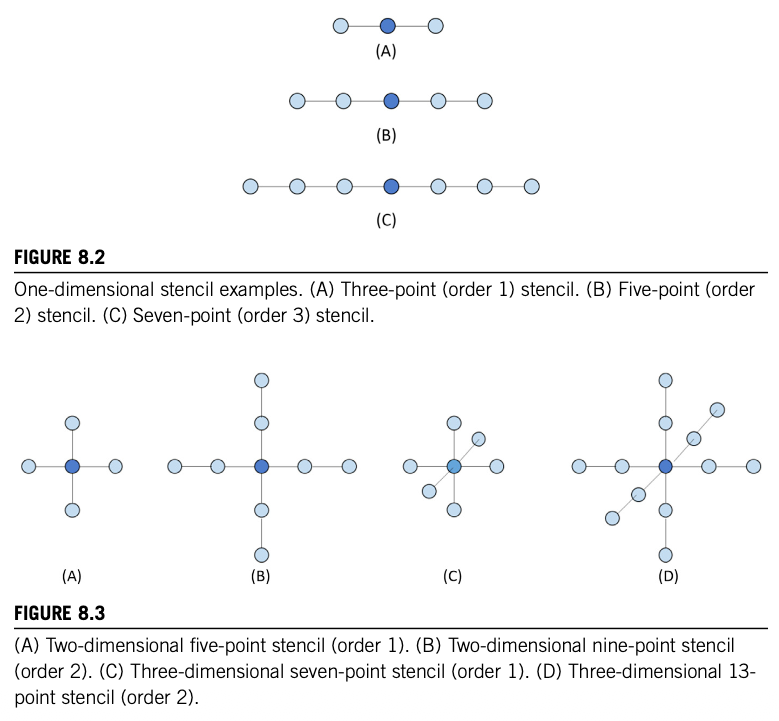
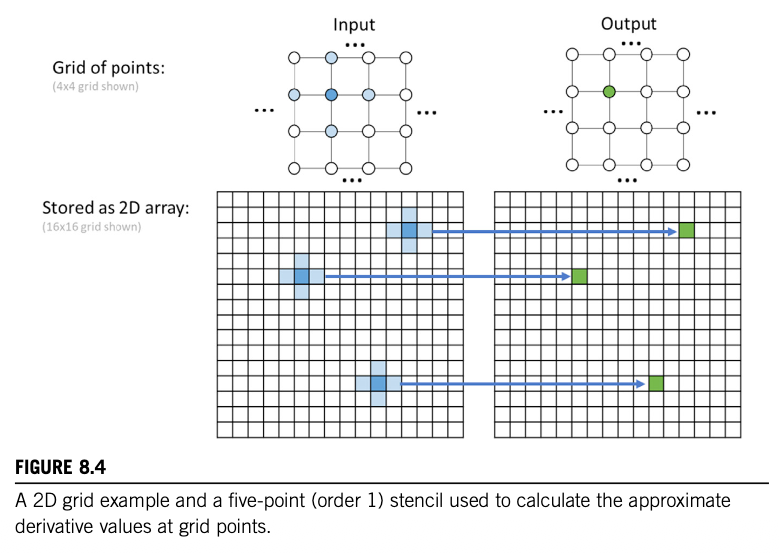
a stencil may specify how the derivative value of a function at a point of interest is approximated by using finite differences between the values of the function at the point and its neighbors.
Parallel stencil: a basic algorithm
We will first present a basic kernel for stencil sweep. For simplicity we assume that there is no dependence between output grid points when generating the output grid point values within a stencil sweep. We further assume that the grid point values on the boundaries store boundary conditions and will not change from input to output, as illustrated in Fig. 8.5. That is, the shaded inside area in the output grid will be calculated, whereas the unshaded boundary cells will remain the same as the input values. This is a reasonable assumption, since stencils are used mainly to solve differential equations with boundary conditions.
Shared memory tiling for stencil sweep
As we saw in Chapter 5, Memory Architecture and Data Locality, the ratio of floating-point operations to global memory accessing operations can be significantly elevated with shared memory tiling. As the reader probably suspected, the design of shared memory tiling for stencils is almost identical to that of convolution. However, there are a few subtle but important differences.
Fig. 8.7 shows the input and output tiles for a 2D five-point stencil applied to a small grid example. A quick comparison with Figure 7.11 shows a small difference between convolution and stencil sweep: The input tiles of the five-point stencil do not include the corner grid points. This property will become important when we explore register tiling later in this chapter. For the purpose of shared memory tiling, we can expect the input data reuse in a 2D five-point stencil to be significantly lower than that in a 3 3 3 convolution. As we discussed in Chapter 7, Convolution, the upper bound of the arithmetic to global memory access ratio of a 2D 3 3 3 convolution is 4.5 OP/B. However, for a 2D five-point stencil, the upper bound on the ratio is only 2.5 OP/B. This is because each output grid point value uses only five input grid values, compared to the nine input pixel values in 3 3 3 convolution.
That is, the larger the T value, the more the input grid point values are reused. The upper bound on the ratio as T increases asymptotically is 13/45 3.25 OP/B. Unfortunately, the 1024 limit of the block size on current hardware makes it difficult to have large T values. The practical limit on T is 8 because an 8 3 8 3 8 thread block has a total of 512 threads. Furthermore, the amount of shared memory that is used for the input tile is proportional to T3. Thus a larger T dramatically increases the consumption of the shared memory. These hardware constraints force us to use small tile sizes for the tiled stencil kernel. In contrast, convolution is often used to process 2D images in which larger tile dimensions (T value) such as 32 3 32 can be used.
There are two major disadvantages to the small limit on the T value that is imposed by the hardware. The first disadvantage is that it limits the reuse ratio and thus the compute to memory access ratio. For T5 8 the ratio for a seven-point stencil is only 1.37 OP/B, which is much less than the upper bound of 3.25 OP/B. The reuse ratio decreases as the T value decreases because of the halo overhead. As we discussed in Chapter 7, Convolution, halo elements are less reused than the nonhalo elements are.

All threads in the block then wait at the barrier to ensure that everyone completes its calculation before they move on to the next output tile plane. Once off the barrier, all threads collaborate to move the contents of inCurr_s to inPrev_s and the contents of inNext_s to inCurr_s.
The advantages of the thread coarsening kernel are that it increases the tile size without increasing the number of threads and that it does not require all planes of the input tile to be present in the shared memory. The thread block size is now only T2 instead of T3, so we can use a much larger T value, such as 32, which would result in a block size of 1024 threads.
Summary
In this chapter we dived into stencil sweep computation, which seems to be just convolution with special filter patterns. However, because the stencils come from discretization and numerical approximation of derivatives in solving differential equations, they have two characteristics that motivate and enable new optimizations. First stencil sweeps are typically done on 3D grids, whereas convolution is typically done on 2D images or a small number of time slices of 2D images. This makes the tiling considerations different between the two and motivates thread coarsening for 3D stencils to enable larger input tiles and more data reuse. Second, the stencil patterns can sometimes enable register tiling of input data to further improve data access throughput and alleviate shared memory pressure.
'ComputerScience > Parallel Programming' 카테고리의 다른 글
| [CUDA] Chap10. Reduction (0) | 2026.03.24 |
|---|---|
| [CUDA] Chap9. Parallel histogram (0) | 2026.03.24 |
| [CUDA] Chap7. Convolution (0) | 2026.03.24 |
| [CUDA] Chap6. Performance considerations (0) | 2026.03.20 |
| [CUDA] Chap5. Memory architecture and data locality (0) | 2026.03.19 |