2026. 3. 24. 17:06ㆍComputerScience/Parallel Programming
Chap10. Reduction
A reduction derives a single value from an array of values. The single value could be the sum, the maximum value, the minimal value, and so on among all elements. The value can also be of various types: integer, single-precision floating-point, double-precision floating-point, half-precision floating-point, characters, and so on. All these types of reductions have the same computation structure.
Like a histogram, reduction is an important computation pattern, as it generates a summary from a large amount of data. Parallel reduction is an important parallel pattern that requires parallel threads to coordinate with each other to get correct results. Such coordination must be done carefully to avoid performance bottlenecks, which are commonly found in parallel computing systems. Parallel reduction is therefore a good vehicle for illustrating these performance bottlenecks and introducing techniques for mitigating them.

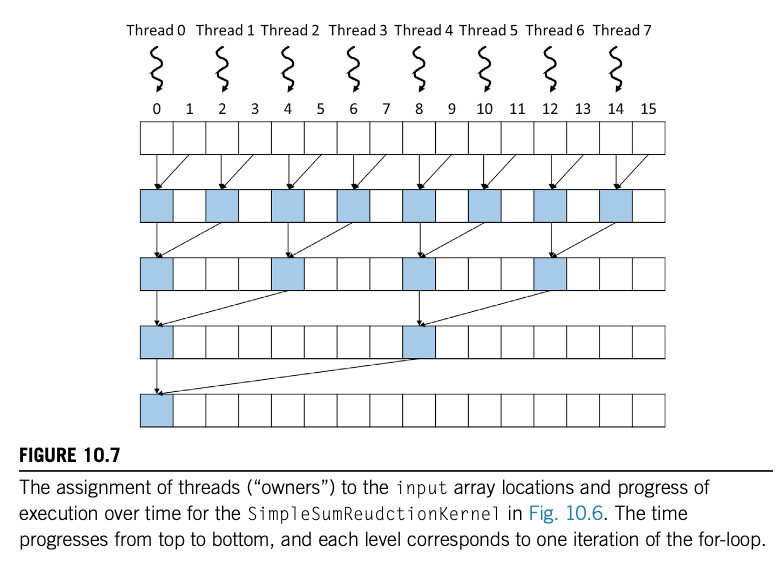
As we have seen, parallel reduction assumes that the order of applying the operator to the input values does not matter. In a max reduction, no matter what the order is for applying the operator to the input values, the outcome will be the
same.
Strictly speaking, floating-point additions are not associative, owing to potentially rounding results for different ways of introducing parentheses. However, most applications accept floating-point operation results to be the same if they are within a tolerable difference from each other.
In terms of time steps, a reduction tree takes log2N steps to complete the reduction process for N input values. Thus it can reduce N5 1024 input values in just ten steps, assuming that there are enough execution resources. During the first step, we need 1 / 2 N5 512 execution resources! Note that the number of resources that are needed diminishes quickly as we progress in time steps. During the final time step, we need to have only one execution resource.
The level of parallelism at each time step is the same as the number of execution units that are required. It is interesting to calculate the average level of parallelism across all time steps. The average parallelism is the total number of operations that are performed divided by the number of time steps, which is (N2 1)/log2N.
Minimizing global memory accesses
The convergent kernel in Fig. 10.9 can be further improved by using shared memory. Note that in each iteration, threads write their partial sum result values out to the global memory, and these values are reread by the same threads and other threads in the next iteration. Since the shared memory has much shorter latency and higher bandwidth than the global memory, we can further improve the execution speed by keeping the partial sum results in the shared memory. This idea is illustrated in Fig. 10.10.


Using the kernel in Fig. 10.11, the number of global memory accesses are reduced to the initial loading of the original contents of the input array and the final write to input[0]. Thus for an N-element reduction the number of global memory accesses is just N+1. Note also that both global memory reads in Fig. 10.11 (line 04) are coalesced. So with coalescing, there will be only (N/32) +1 global memory requests. For the 256-element example the total number of global memory requests that are triggered will be reduced from 36 for the kernel in Fig. 10.9 to 8+15 9 for the shared memory kernel in Fig. 10.10, a 4 3 improvement. Another benefit of using shared memory, besides reducing the number of global memory accesses, is that the input array is not modified. This property is useful if the original values of the array are needed for some other computation in another part of the program.

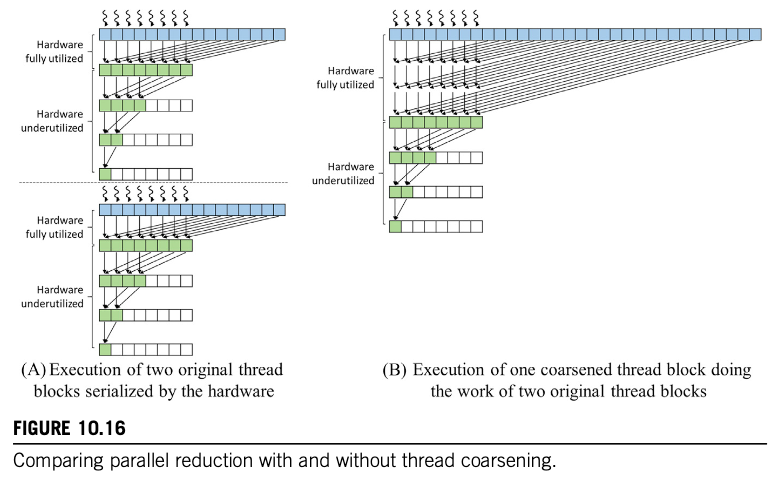
The remaining three steps execute the reduction tree in which half the threads drop out each step, underutilizing the hardware. Moreover, each step requires a barrier synchronization as well as accesses to shared memory.
Theoretically, we can increase the coarsening factor well beyond two. However, one must keep in mind that as we coarsen threads, less work will be done in parallel. Therefore increasing the coarsening factor will reduce the amount of data parallelism that is being exploited by the hardware. If we increase the coarsening factor too much, such that we launch fewer thread blocks than the hardware is capable of executing, we will no longer be able to take full advantage of the parallel hardware execution resources. The best coarsening factor ensures that there are enough thread blocks to fully utilize the hardware, which usually depends on the total size of the input as well as the characteristics of the specific device.
Summary
The parallel reduction pattern is important, as it plays a key row in many data- processing applications. Although the sequential code is simple, it should be clear to the reader that several techniques, such as thread index assignment for reduced divergence, using shared memory for reduced global memory accesses, segmented reduction with atomic operations, and thread coarsening, are needed to achieve high performance for large inputs. The reduction computation is also an important foundation for the prefix-sum pattern that is an important algorithm component for parallelizing many applications and will be the topic of Chapter 11, Prefix Sum (Scan).
'ComputerScience > Parallel Programming' 카테고리의 다른 글
| [CUDA] Chap11. Prefix sum (scan) (0) | 2026.03.24 |
|---|---|
| [CUDA] Chap9. Parallel histogram (0) | 2026.03.24 |
| [CUDA] Chap8. Stencil (0) | 2026.03.24 |
| [CUDA] Chap7. Convolution (0) | 2026.03.24 |
| [CUDA] Chap6. Performance considerations (0) | 2026.03.20 |