2026. 3. 24. 20:48ㆍComputerScience/Parallel Programming
Chap11. Prefix sum (scan)
Our next parallel pattern is prefix sum, which is also commonly known as scan. Parallel scan is frequently used to parallelize seemingly sequential operations, such as resource allocation, work assignment, and polynomial evaluation. In general, if a computation is naturally described as a mathematical recursion in which each item in a series is defined in terms of the previous item, it can likely be parallelized as a parallel scan operation. Parallel scan plays a key role in massively parallel computing for a simple reason: Any sequential section of an application can drastically limit the overall performance of the application. Many such sequential sections can be converted into parallel computation with parallel scan.

This is because we are using N threads. While many of the threads stop participating in the execution of the for-loop, some of them still consume execution resources until the entire warp completes execution.
If the hardware does not have enough resources (i.e., if P is small), the parallel algorithm could end up needing more steps than the sequential algorithm. Hence the parallel algorithm will be slower. Second, all the extra work consumes additional energy. This makes the kernel less appropriate for power-constrained environments such as mobile applications.
its computation can be efficiently performed with shuffle instructions within warps. We will see later in this chapter that it is an important component of the modern high-speed parallel scan algorithms.
Coarsening for even more work efficiency
The overhead of parallelizing scan across multiple threads is like reduction in that it includes the hardware underutilization and synchronization overhead of the tree execution pattern. However, scan has an additional parallelization overhead, and that is reduced work efficiency. As we have seen, parallel scan is less work efficient than sequential scan.

That is, we transfer data between shared memory and global memory in a coalesced manner and perform the memory accesses with the unfavorable access pattern in shared memory.
With this three-phase approach, we can use a much smaller number of threads than the number of elements in a section.

Readers who are familiar with computer arithmetic algorithms should recognize that the principle behind the segmented scan algorithm is quite similar to the principle behind carry look-ahead in hardware adders of modern processors. This should be no surprise, considering that the two parallel scan algorithms that we have studied so far are also based on innovative hardware adder designs.
Dynamic block index assignment decouples the assignment of the thread block index from the built-in blockIdx.x. In the single-pass scan, the value of the bid variable of each block is no longer tied to the value of blockIdx.x. Instead, it is determined by using the following code at the beginning of the kernel.
This guarantees that all scan blocks are scheduled linearly and prevents a potential deadlock. In other words, if a block obtains a bid value of i, then it is guaranteed that a block with value i2 1 has been scheduled because it has executed the atomic operation.
Summary
In this chapter we studied parallel scan, also known as prefix sum, as an important parallel computation pattern. Scan is used to enable parallel allocation of resources to parties whose needs are not uniform. It converts seemingly sequential computation based on mathematical recurrence into parallel computation, which helps to reduce sequential bottlenecks in many applications. We show that a simple sequential scan algorithm performs only N2 1, or O(N), additions for an input
of N elements.
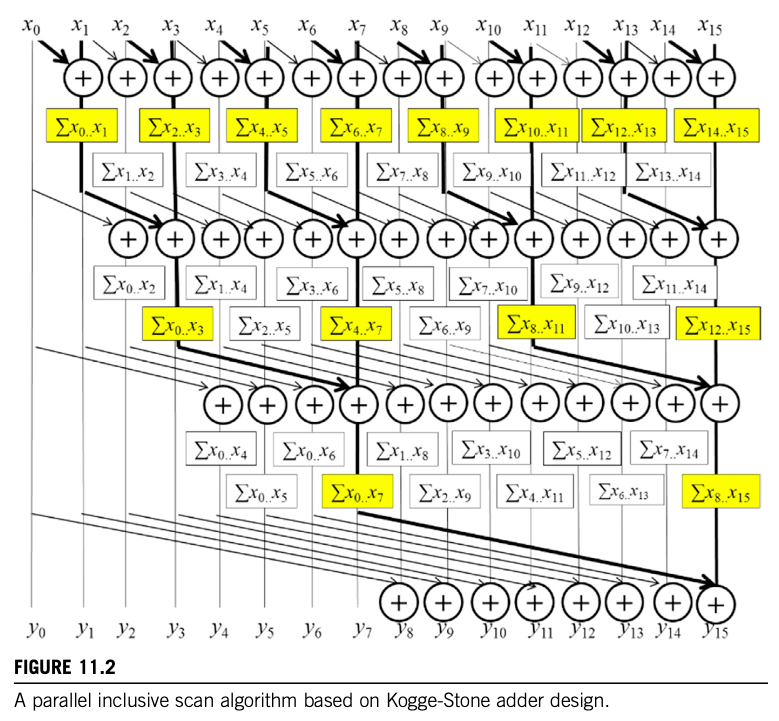
We first introduced a parallel Kogge-Stone segmented scan algorithm that is fast and conceptually simple but not work-efficient. The algorithm performs O(N log2N) operations, which is more than its sequential counterpart. As the size of the dataset increases, the number of execution units that are needed for a parallel algorithm to break even with the simple sequential algorithm also increases. Therefore Kogge-Stone scan algorithms are typically used to process modest-sized scan blocks in processors with abundant execution resources.
We then presented a parallel Brent-Kung segmented scan algorithm that is conceptually more complicated. Using a reduction tree phase and a reverse tree phase, the algorithm performs only 2 N2 3, or O(N), additions no matter how large the input datasets are. Such a work-efficient algorithm whose number of operations grows linearly with the size of the input set is often also referred to as a data-scalable algorithm. Although the Brent-Kung algorithm has better work efficiency than the Kogge-Stone algorithm, it requires more steps to complete. Therefore in a system with enough execution resources, the Kogge-Stone algorithm is expected to have better performance despite being less work efficient.
We also applied thread coarsening to mitigate the hardware underutilization and synchronization overhead of parallel scan and to improve its work efficiency. Thread coarsening was applied by having each thread in the block perform a work-efficient sequential scan on its own subsection of input elements before the threads collaborate to perform the less work-efficient block-wide parallel scan to produce the entire block’s section.
We presented a hierarchical scan approach to extend the parallel scan algorithms to handle input sets of arbitrary sizes. Unfortunately, a straightforward, three-kernel implementation of the segmented scan algorithm incurs redundant global memory accesses whose latencies are not overlapped with computation. For this reason we also presented a domino-style hierarchical scan algorithm to enable a single-pass, single-kernel implementation and improve the global memory access efficiency of the hierarchical scan algorithm. However, this approach requires a carefully designed adjacent block synchronization mechanism using atomic operations, thread memory fence, and barrier synchronization. Special care also must be taken to prevent deadlocks by using dynamic block index assignment.
There are further optimization opportunities for even higher performance implementations using, for example, warp-level shuffle operations. In general, implementing and optimizing parallel scan algorithms on GPUs are complex processes, and the average user is more likely to use a parallel scan library for GPUs such as Thrust (Bell and Hoberock, 2012) than to implement their own scan kernels from scratch. Nevertheless, parallel scan is an important parallel pattern, and it offers an interesting and relevant case study of the tradeoffs that go into optimizing parallel patterns.
'ComputerScience > Parallel Programming' 카테고리의 다른 글
| [CUDA] Chap10. Reduction (0) | 2026.03.24 |
|---|---|
| [CUDA] Chap9. Parallel histogram (0) | 2026.03.24 |
| [CUDA] Chap8. Stencil (0) | 2026.03.24 |
| [CUDA] Chap7. Convolution (0) | 2026.03.24 |
| [CUDA] Chap6. Performance considerations (0) | 2026.03.20 |